
Fire Door Safety Defects: 7 Common Issues to Spot

Updated: Sep 16
Table of Contents
Why Fire Door Defects Put Your Whole Building at Risk
The 7 Most Common Fire Door Safety Defects
1. Excessive Gaps and Wrong Clearance Dimensions
2. Damaged or Missing Intumescent Smoke Seals
3. Fire Door Latching Failure
4. Faulty Door Closers and Automatic Closing Devices
5. Damaged Door Leaves, Frames, and Hinge Integrity
6. Missing, Painted-Over, or Unreadable Certification Labels
7. Improper Hardware, Obstructions, and Vision Panel Damage
Fire Door Gap Requirements: What the Gauge Tells You
NFPA 80 Fire Door Inspection Requirements: What You Must Document
Environmental Factors That Speed Up Door Deterioration
Digital Record-Keeping for Compliance and Liability Protection
Conclusion: Build a Maintenance Log That Catches Defects Early
Frequently Asked Questions
Last Updated: September 7, 2026
Fire door safety defects are the specific failures, from oversized gaps to broken latches, that prevent a door assembly from containing fire and smoke as designed. Our certified fire door inspectors perform audits according to NFPA 80 standards, revealing hidden vulnerabilities that could compromise lives and property. We compiled this list of the most common fire door safety defects and how to spot them before an auditor does.
A defective fire door can turn a contained fire into a building-wide threat, and under NFPA 80, the building owner carries responsibility for periodic inspection and maintenance. Below, we break down the seven defects behind most non-compliant assemblies, what the clearance gauge tells you, and how to build a record-keeping system that protects you from liability.
Why Fire Door Defects Put Your Whole Building at Risk
A fire door is a precision assembly of interdependent components, and a single failure compromises the entire system. When a door closer is weak, the door may not latch under positive pressure, allowing smoke to pour into corridors and stairwells.
The danger is that these defects are rarely visible from a casual walk-through. A door that appears perfectly normal during daily use can fail catastrophically during a fire because the gap is too wide or the intumescent seal has been painted over. This is why the [NFPA 80(/post/how-to-maintain-nfpa-80-fire-door-compliance) standard for fire doors | nfpa.org] requires documented inspections at defined intervals rather than relying on visual checks alone.
The 7 Most Common Fire Door Safety Defects
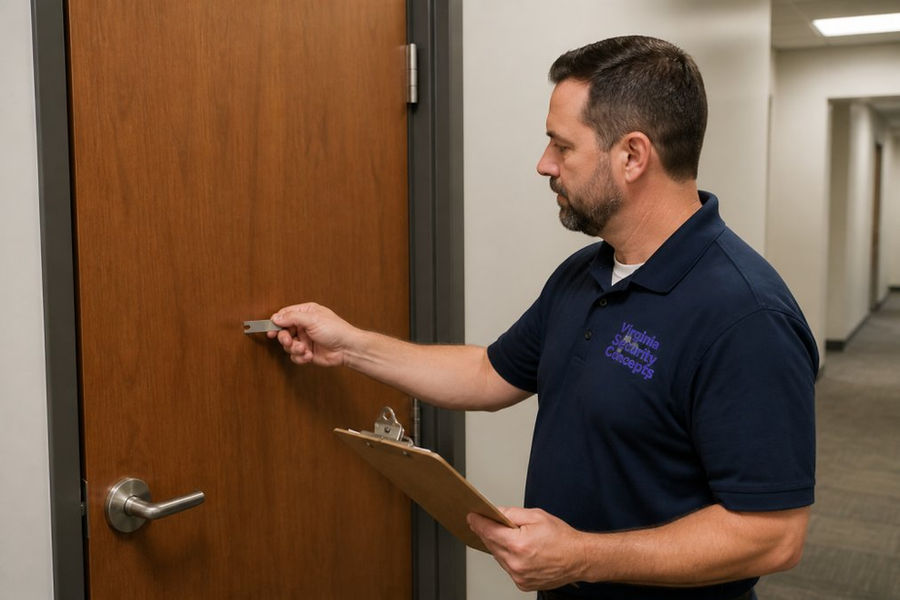
The most common fire door safety defects fall into seven categories, each with its own visual cues and functional consequences. Recognizing them during routine walks is the first line of defense, but a certified inspection remains the only way to confirm compliance.
1. Excessive Gaps and Wrong Clearance Dimensions
The gap between the door leaf and the frame is measured with a specialized tool called a door gap gauge. Under NFPA 80, the clearance at the sides and top of the door must not exceed the width of a designated gauge, typically around 1/8 inch, while the bottom clearance is measured separately (nfpa.org).
Oversized gaps allow smoke and toxic gases to bypass the door before the intumescent seal activates. A common mistake is assuming any gap that looks "small" is acceptable; the tolerance is strict, and the only reliable method is to measure every perimeter gap at each inspection.
2. Damaged or Missing Intumescent Smoke Seals
Intumescent smoke seals are the gaskets embedded in the door frame or mounted on the door leaf that expand when exposed to heat, sealing the gap against fire and smoke. When these seals are missing, damaged, or painted over, the door loses its ability to contain smoke during the critical early minutes of a fire.
A painted-over seal is insidious because the door looks fine at a glance, yet the paint restricts expansion. Inspectors should check that seals are intact, firmly attached, and free of any coating that would impede expansion.
3. Fire Door Latching Failure
A fire door latching failure occurs when the latch bolt does not fully engage the strike plate, leaving the door able to spring open under pressure. This is frequently caused by misaligned hardware, a worn latch, or a door leaf that has sagged on its hinges.
Testing the latch is simple: with the door open halfway, release it and confirm the latch engages the strike plate without bouncing back. A door that does not latch securely is a critical defect, as it cannot contain smoke or fire regardless of other components.
4. Faulty Door Closers and Automatic Closing Devices
Every fire door in a means of egress must be self-closing, and the automatic closing device must be able to close and latch the door from any open position. Faulty door closers are among the most frequently cited deficiencies, often because the door is held open by a disengaged closer arm or the hydraulic speed is set incorrectly.
A door that slams shut or takes more than a few seconds to close is not operating to specification. Inspectors should verify the closer brings the door fully to the latch without assistance and that hold-open devices release automatically upon fire alarm activation.
5. Damaged Door Leaves, Frames, and Hinge Integrity
The door leaf and frame must maintain their structural integrity to resist fire penetration. Defects in this category include holes in the door leaf, warping, delamination of the core, and frame damage that compromises the fire-resistance rating. Hinges must be securely fastened with screws of the correct length; stripped screw holes are a common defect that allows the door to sag.
Damage is often caused by impact from carts or equipment, and repair is not as simple as filling the hole. The assembly's fire rating depends on the integrity of the entire leaf, so any breach typically requires door replacement rather than a cosmetic patch.
6. Missing, Painted-Over, or Unreadable Certification Labels
Every fire door assembly carries a certification label from the manufacturer that identifies the fire-resistance rating of the components. This label is the only proof that the door, frame, and hardware are rated for the assembly. When the label is missing, painted over, or unreadable, the door's rating cannot be verified, and the assembly is automatically non-compliant.
Painting over a label is frequent during renovation work. Facility managers should instruct painters to mask off all fire door labels before any coating is applied.
7. Improper Hardware, Obstructions, and Vision Panel Damage
All hardware on a fire door assembly must be listed for fire-rated applications, and field modifications without approval void the rating. Common defects include non-rated locksets, improperly installed door viewers, and the use of standard hinges instead of fire-rated hinges.
Obstructions are equally problematic. Door wedges, kick-down holders, and other devices that hold a fire door open are prohibited unless part of an approved, release-latching system. Vision panels must have intact fire-rated glass and gaskets; any crack or missing gasket compromises the assembly.
Fire Door Gap Requirements: What the Gauge Tells You
Fire door gap requirements are precise, and the door gap gauge is the tool that removes guesswork from the inspection. For most swinging fire doors with composite or steel cores, the clearance between the door and the frame on the sides and top must be no more than 1/8 inch, measured with the appropriate wire gauge. The bottom clearance is different: it must be between 3/4 inch and 1 inch to allow for threshold and floor variations, but never so wide that smoke can pass unimpeded.
The gauge is a flat metal tool with precision-cut notches, each labeled with its width in inches. The inspector selects the notch matching the allowable tolerance, typically 1/8 inch for side and top gaps, and attempts to insert it. If the notch fits snugly, the gap is within tolerance; if the next larger notch also fits, the gap is excessive and must be corrected.
A common field error is measuring only one point along the hinge or strike side. A warped leaf or settled frame can have a compliant 1/8-inch gap at the top but a 1/4-inch gap at the bottom. The correct procedure is to measure at three points on each vertical side and two points across the top edge, eight measurements per door leaf, and every one must pass.
Watch Out A gap that is too tight is also a defect. If the 1/8-inch notch will not fit at all, the door may bind against the frame, preventing the latch from fully engaging. This is a common issue in buildings where doors were painted multiple times without stripping, effectively reducing the gap to zero.
For a pair of doors, the gap between the active and inactive leaves must also not exceed 1/8 inch, and the astragal or coordinator must be present and functional. A gap correct on a single door but excessive on a pair is a frequent finding in corridors and stairwell enclosures.
The bottom gap is measured with a separate tapered gauge or ruler. NFPA 80 allows up to 3/4 inch for the bottom of the door, but only if the door is not in a smoke barrier. For smoke-rated assemblies, the bottom gap is often tighter, and a drop seal or automatic bottom seal changes the measurement entirely. The inspector must know which rating applies before judging the bottom gap.
The gauge tells you about the gap at inspection, but not why it is wrong. An excessive gap on the hinge side often indicates loose hinge screws or a sagging leaf; on the strike side, it frequently points to a frame pushed out of plumb by settling or impact damage. Correcting the gap without addressing the root cause will result in the defect reappearing within months. The report should note both the measurement and the suspected cause.
NFPA 80 Fire Door Inspection Requirements: What You Must Document
NFPA 80 fire door inspection requirements mandate that fire door assemblies be inspected and tested at intervals not exceeding one year, with the inspection documented and the records retained for the life of the assembly. The inspection must confirm that the door is operational, free of damage, and that all components are present and functional.
The documentation is as important as the inspection itself. A written record must include the date, the inspector's name, the specific deficiencies found, and the corrective action taken. This record is the evidence that the building owner has fulfilled the duty to maintain the assembly, and it is the first document requested during an insurance review or a code enforcement audit. Guidance on structuring these records is available through resources on fire door inspection documentation.
Environmental Factors That Speed Up Door Deterioration
Environmental conditions accelerate fire door defects. In schools and coastal regions, high humidity causes wooden door leaves to swell and shrink, stressing hinges and creating gaps that change with the seasons. HVAC pressure differentials in commercial buildings force doors to work harder, wearing out closers and latches prematurely.
Corrosion is another hidden factor, particularly on hardware near salt water or in areas with frequent temperature swings. A hinge that looks solid may have internal corrosion preventing smooth operation. Schedule inspections at the same point in the seasonal cycle each year so gap measurements are comparable and not skewed by humidity-related expansion.
Digital Record-Keeping for Compliance and Liability Protection
Paper inspection logs are easy to lose, difficult to audit, and nearly impossible to defend in court. Digital record-keeping gives facility managers a searchable, timestamped history of every assembly, including inspection dates, deficiencies, corrective actions, and photographic evidence. This is not just administrative convenience; it is a liability shield that directly affects your legal exposure and insurance coverage.
In a post-fire lawsuit, the plaintiff's attorney will almost certainly request the inspection and maintenance records for every fire door in the path of the fire. If the records show that a defect was identified but not corrected, or if the records are missing entirely, the building owner faces a presumption of negligence. Under the doctrine of negligent maintenance, a plaintiff does not need to prove that the defect caused the fire, only that it allowed the fire or smoke to spread further than it otherwise would have.
Key Takeaway A digital log with timestamps and photographic evidence demonstrates a proactive maintenance program. The absence of such a log shifts the burden of proof onto the building owner to show that the defect was not a known hazard.
Commercial property policies typically include a warranty clause that the building will be maintained in accordance with applicable codes, including NFPA 80. A failure to maintain inspection records can be cited by the carrier as a breach of that warranty, giving the insurer grounds to deny a claim or rescind the policy retroactively. A fire door defect discovered after a loss could result in the carrier refusing to pay for the fire damage itself, not just the additional damage caused by the defective door.
A common litigation pattern is the "missing record" defense, where the owner claims inspections were performed but paper logs were lost or never created consistently. Courts are skeptical of this defense, particularly for sophisticated commercial entities. Digital records eliminate this vulnerability because they cannot be easily altered or lost and include metadata proving when each entry was created.
A simple spreadsheet with columns for assembly location, inspection date, inspector name, defect description, corrective action, and photo attachment is a significant improvement over paper. More robust options include computerized maintenance management systems (CMMS) that route a deficiency found during inspection automatically to a maintenance technician for repair. The key is not the tool's sophistication but the consistency of data entry and retention of photographic evidence.
Each record should include the unique identifier of the door assembly, the inspection date, the name and certification number of the inspector, the specific NFPA 80 section evaluated, the gap clearance measurements, and a photograph of the certification label. When a defect is found, the record should include a photograph of the defect, a description of the corrective action, and a follow-up inspection date to verify the repair. This level of detail is what insurance defense attorneys and fire marshals expect, and it is the difference between a defensible compliance program and a paper trail that collapses under scrutiny.
Conclusion: Build a Maintenance Log That Catches Defects Early
A fire door inspection is not a single event; it is an ongoing cycle of identification, correction, and documentation. The defects listed here are common precisely because they develop gradually and are easy to miss without a systematic approach. Building a maintenance log that tracks every assembly, schedules annual inspections, and records every repair is the most effective way to catch defects before they become violations.
The technical precision of Virginia Security Concepts is unmatched. Our risk assessment is thorough, and the consultative approach ensures your facility's safety is paramount. Our certified fire door inspectors perform audits according to NFPA 80 standards, revealing hidden vulnerabilities that could compromise lives and property. Book online to schedule your inspection and get a clear picture of your compliance status before an auditor finds it for you.
Frequently Asked Questions
What are the NFPA 80 standards for fire door inspections?
NFPA 80 requires fire door assemblies to be inspected at least annually, with a written record kept of the findings. The inspection must verify the door is self-closing and positively latches, check for damage to the door leaf and frame, confirm clearance dimensions are within tolerance, and ensure all hardware is fire-rated and functional. A certified inspector must perform the check, and any defects found must be repaired promptly to maintain compliance.
What are the most common reasons fire doors fail inspections?
The most frequent failures are excessive gaps around the door perimeter, damaged or missing intumescent smoke seals, and fire door latching failure where the latch does not fully engage the strike plate. Faulty door closers that do not fully close the door, painted-over certification labels, and improperly rated hardware also appear regularly. These defects are often simple to spot but require immediate correction to restore the fire door assembly's integrity.
How often should fire doors be professionally inspected?
NFPA 80 mandates a professional inspection at least once every 12 months. For facilities with heavy traffic, such as schools and commercial buildings, more frequent checks are wise. Between annual inspections, facility managers should conduct monthly visual checks for obvious issues like wedged doors, missing seals, or damaged hardware. Keeping a maintenance log of these checks supports compliance and helps catch small problems before they become costly violations.
Can you add locks or hardware to a fire door?
Only hardware that is specifically fire-rated for the door assembly may be added. Standard locks, latches, or strikes can compromise the door's fire-resistance rating and void its certification label. Any new hardware must bear the appropriate fire-rating markings and be installed in a way that does not weaken the door leaf or frame. Consult a certified fire door inspector before modifying any door to ensure the change complies with NFPA 80.
Book Online


Comments