
Professional Residential Lock Rekeying Services
Updated: Sep 16
Table of Contents
What Is Professional Residential Lock Rekeying?
When Should You Rekey Your Home Locks?
Rekey vs Replace Locks: Which Option Protects Your Home?
How the Professional Rekeying Process Works
Cost to Rekey House Locks: What to Expect
Home Security Vulnerability Assessment: Beyond Rekeying
Why Professional Installation Matters for Lock Security
Frequently Asked Questions
Last Updated: September 2, 2026
What Is Professional Residential Lock Rekeying?
Residential lock rekeying is the process of changing the internal pins and springs inside an existing lock cylinder so that old keys no longer work and only new keys can operate the lock. A locksmith removes the lock cylinder, disassembles the internal mechanism, and reconfigures the key pins to match a new key cut, preserving your existing door hardware while providing complete security control.
Rekeying keeps your current deadbolts, lever handles, and strike plates in place, you're only changing which key opens them. This makes it far more practical than replacing every lock when you need fresh security after moving into a new home, losing keys, or ending a relationship with someone who had access.
At Virginia Security Concepts, we understand that rekeying addresses one of the most common residential security concerns: unknown key holders. When you buy a home, inherit a rental property, or part ways with someone who had keys, rekeying eliminates the uncertainty. You know exactly who holds access because you control the new keys from day one.
The process works because locks operate on a simple mechanical principle. Inside the cylinder sits a series of spring-loaded pins at different heights. Your key pushes these pins to exact positions, allowing the cylinder to turn. When we rekey, we adjust those pin heights to match a completely different key profile. The old key becomes useless; the new one becomes the only match.
Pro Tip Professional rekeying can be a cost-effective alternative to lock replacement because you're only paying for labor and new pins, not new hardware.
When Should You Rekey Your Home Locks?
Rekeying makes sense when security control has been compromised or transferred. Moving into a new home is the most obvious trigger, previous owners, contractors, real estate agents, and inspectors may have held keys. Rekeying on move-in day ensures only your keys open your doors.
If you've experienced a break-up, divorce, or ended a living arrangement with someone who had key access, rekeying is the fastest way to restore exclusive control. Lost or stolen keys are another clear trigger; rekeying eliminates the risk that a found key could be duplicated without permission.
Rental property transitions demand rekeying between tenants to prevent former occupants from returning after lease end. Long-term homeowners should consider rekeying if they've given keys to contractors, housekeepers, or service providers over the years.
Watch Out Waiting too long to rekey after [a security](/our-services-overview) event creates liability. If someone with an old key causes damage or theft, you may face questions about negligence. Act promptly when control is compromised.
Rekey vs Replace Locks: Which Option Protects Your Home?
The choice between rekeying and replacing locks hinges on the condition of your hardware and your security goals. Rekeying is right if your current locks are mechanically sound, properly installed, and meet your security needs, you simply need fresh key control. Replacing locks makes sense if hardware is damaged, outdated, or doesn't meet modern security standards.
Rekeying advantages: Cost-effective, preserves existing hardware, fast installation, minimal disruption. Replacement advantages: Upgrades to higher-security locks like deadbolts with reinforced strike plates, smart locks with keypad or biometric access, or master key systems.
Many homeowners benefit from a hybrid approach: rekey the existing locks in good condition and replace the ones that are worn, damaged, or inadequate. Virginia Security Concepts conducts thorough security vulnerability assessments that evaluate every lock on your property, examining cylinder condition, strike plate integrity, door frame strength, and alignment. We determine whether rekeying alone solves your security needs or whether selective replacement strengthens your overall protection.
Approach | Best For | Cost Range | Timeline | Security Impact |
Rekeying existing locks | Key control after move-in or security event | Lower | Same-day | Restores exclusive access |
Replacing select locks | Upgrading weak hardware | Medium | 1-2 days | Improves lock strength |
Full replacement | Comprehensive security overhaul | Higher | 2-3 days | Modernizes all entry points |
Hybrid (rekey + replace) | Balancing cost and security | Medium | 1-2 days | Optimizes protection and budget |

How the Professional Rekeying Process Works
The rekeying process begins with removing the lock cylinder from your door using a small tool to extract it from the exterior side of the deadbolt or lever lock. Once removed, the cylinder is placed in a specialized vise. The locksmith inserts a removal tool into the top of the cylinder to push out the retaining pin, releasing the internal plug, the part that rotates when your key turns.
The locksmith examines the old key pins, which sit at different heights depending on your original key's profile. These pins are removed and replaced with new pins matched to your new key. The springs remain in place; only the pins change. Once new pins are installed, the locksmith tests the new key in the cylinder to ensure smooth operation. If adjustment is needed, pins are swapped or repositioned until the key operates smoothly.
The cylinder is then reinstalled into your door lock, with verification that the lock engages and disengages properly and both exterior and interior sides function correctly. A final check ensures the old key no longer operates the lock.
For homes with multiple locks, this process repeats for each cylinder. Many homeowners choose to rekey all entry points to a single key, simplifying key management through "keyed alike" rekeying.
Key Takeaway Professional rekeying requires precision in pin selection and installation to ensure smooth operation.
Cost to Rekey House Locks: What to Expect
Rekeying costs vary based on the number of locks, lock type, and whether you want all locks keyed alike. Many professional locksmiths charge a per-lock fee plus a service call charge. For budgeting purposes, rekeying residential locks can be less expensive than replacing those same locks with new hardware since you're only paying for the locksmith's time and new internal pins, not new lock bodies or installation hardware.
Emergency or after-hours rekeying typically costs more than daytime service. Scheduling rekeying during business hours is often the most economical approach.
Virginia Security Concepts provides competitive pricing for professional residential lock rekeying services and includes a thorough security assessment as part of the service. Contact us for a detailed quote tailored to your home's specific needs.
Best For Homeowners who've just purchased a property or experienced a security event and need fast, affordable key control restoration without replacing existing hardware.
Home Security Vulnerability Assessment: Beyond Rekeying
Rekeying addresses key control, but it's only one component of comprehensive home security. A complete vulnerability assessment examines all entry points, lock hardware, door frames, and structural weaknesses that could compromise your home's protection.
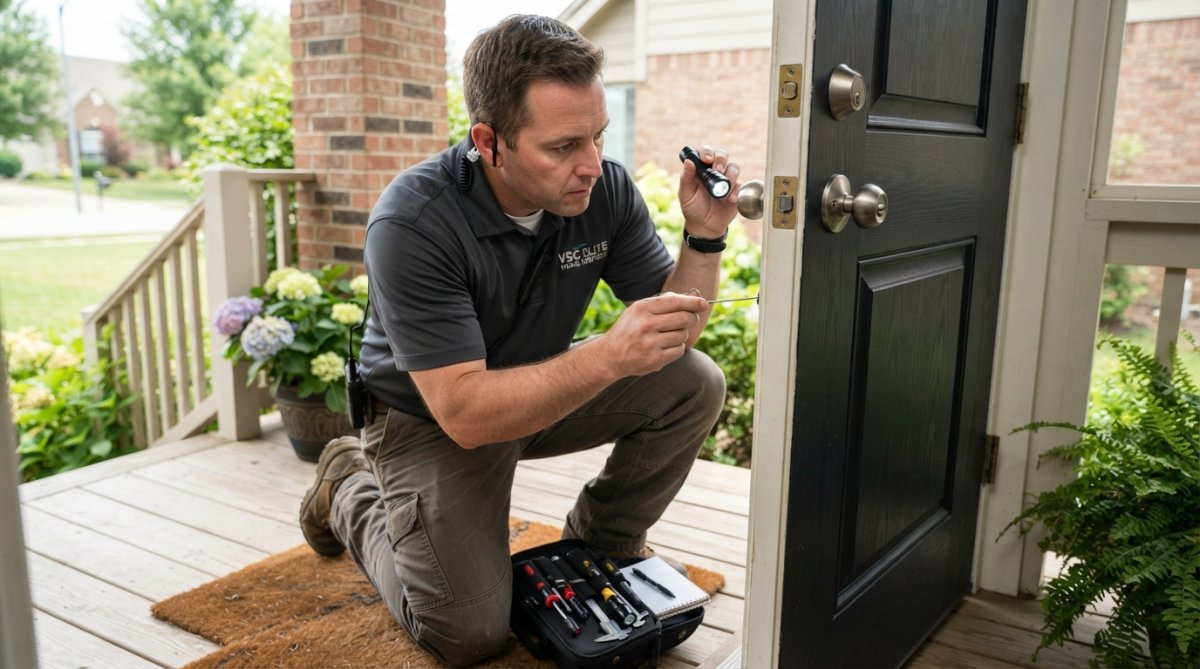
During a security assessment, a locksmith evaluates whether your deadbolts meet modern standards. Many older homes have single-cylinder deadbolts without reinforced strike plates, which can fail under pressure even if the lock itself is sound. Door frame integrity matters as much as lock quality, a deadbolt is only as strong as the frame it's mounted to. A security assessment examines frame condition and identifies repairs needed before rekeying provides meaningful protection.
Entry point coverage is critical. Many homeowners focus on the front door and overlook side doors, patio doors, garage entries, and windows. A comprehensive assessment maps all potential entry points and ensures each one has appropriate locks.
Master key systems are worth considering for larger homes, vacation properties, or multi-unit residential buildings. A master key system allows one key to open multiple locks while permitting individual locks to be opened by their own unique keys. Virginia Security Concepts specializes in designing and implementing master key systems tailored to your property's specific access needs.
Smart lock compatibility is increasingly relevant. A security assessment evaluates whether your doors and frames support keypad locks, biometric locks, or remote-access smart locks.
Assessment Component | What It Evaluates | Why It Matters |
Lock mechanism | Pin tumbler condition, cylinder strength | Determines if rekeying is sufficient or replacement needed |
Strike plate | Installation, reinforcement, alignment | Weak strike plates fail under force regardless of lock quality |
Door frame | Structural integrity, warping, cracks | Poor frames compromise lock performance |
Entry point coverage | All doors and windows assessed | Incomplete coverage leaves vulnerabilities |
Master key potential | Multi-lock access needs | Simplifies management for larger properties |
Smart lock readiness | Door compatibility, electrical access | Supports future upgrades without structural work |
Why Professional Installation Matters for Lock Security
DIY rekeying is theoretically possible, but professional installation offers critical advantages. A licensed locksmith brings specialized tools, precise technique, and accountability that DIY approaches cannot match.
Specialized tools ensure precise pin selection and smooth reassembly. Without these tools, you risk damaging the cylinder, misaligning pins, or creating a lock that binds or fails to operate smoothly. Precision in pin selection is non-negotiable, a locksmith uses your new key to determine exact pin heights and selects pins that match your key's profile perfectly. Mismatched pins create a lock that's difficult to turn, binds under pressure, or wears prematurely.
Professional locksmiths carry liability insurance and offer warranties on their work. If something goes wrong, you have recourse. DIY rekeying leaves you responsible for any mistakes or damage. A professional can complete the job more efficiently than a DIY approach.
Virginia Security Concepts employs licensed technicians trained in precise rekeying technique. We use professional-grade tools and materials, ensure smooth lock operation, and stand behind our work. Our consultative approach means we assess whether rekeying alone meets your security needs or whether additional upgrades strengthen your protection.
Professional residential lock rekeying provides fast, cost-effective key control when you move into a new home, experience a security event, or need to manage access to your property. Rekeying is most effective when paired with a thorough security vulnerability assessment. Virginia Security Concepts evaluates your entire home's entry points, identifies structural or hardware weaknesses, and recommends upgrades that meaningfully improve your protection.
NFPA 80 fire door standards and compliance requirements ensure that any door modifications maintain fire safety ratings. Consumer Reports on home security and lock quality provides independent guidance on lock selection and installation. National Association of Certified Home Inspectors guidelines on residential security assessment outlines best practices for evaluating entry point protection.
Book a security assessment with Virginia Security Concepts today and discover what vulnerabilities exist in your home's current protection. Our team identifies hidden security gaps, recommends targeted rekeying or upgrades, and implements solutions that restore your peace of mind.
Frequently Asked Questions
Q: What is the difference between rekeying and replacing locks?
A: Rekeying changes the internal key pins inside your existing lock hardware so old keys no longer work. Replacement removes the entire lock and installs a new one. Rekeying is often faster and less expensive, making it ideal for homeowners who want to secure their property after moving in or changing occupants. Replacement is necessary when locks are damaged, broken, or when you want to upgrade to higher-security deadbolts or smart locks.
Q: When should you rekey your home locks?
A: Rekey your locks when you move into a new home, after losing keys, when household members move out, or after a security breach. New homeowners should prioritize rekeying immediately for peace of mind, since you cannot verify who has copies of previous keys. If you suspect unauthorized key access or want to consolidate multiple locks to a single master key system, professional rekeying ensures complete key control and eliminates security gaps.
Q: How much does professional lock rekeying cost on average?
A: The cost to rekey house locks depends on the number of locks, their type, and your location. Pricing varies based on lock complexity, brand compatibility, and whether you want all locks keyed to a single master key. Contact a licensed technician for a quote tailored to your specific needs.
Q: Can all residential locks be rekeyed?
A: Most standard residential locks from manufacturers like Schlage and Kwikset can be rekeyed by a professional. However, some high-security locks, specialized deadbolts, or older lock models may have limitations. Smart locks and electronic locks typically cannot be rekeyed in the traditional sense. A licensed technician can assess your locks during a security evaluation and recommend rekeying where possible or suggest replacement options for locks that cannot be modified.
Book Online
This article was written using GrandRanker


Comments